Posts Tagged ‘salt lake city utah massage’

Trigger Point Therapy - Muscle Relief Through Trigger Point Massage

Tuesday, November 9th, 2010

What exactly is a Trigger Point or, more technically called, Myofascial Trigger Points (TrP)? They are simply a firm, tangible, tender spot found in any given muscles with symptoms including deep, aching pain, numbness, inflammation and a loss of range of motion. Many people would equate these spots to knots. In my practice, I see these occur predominantly in the back/neck and Gluteal Muscles, but they can be found on any muscle in the body. These “knots” are also usually accompanied by referred pain. Referral Pain is pain that is felt elsewhere from where the source is. For example, if I was applying pressure to a tender Trigger Point in the Lower Back of a client, they may also feel that tender pain dwelling in their Hamstring.

Trigger Point Therapy has become very popular since it was first used in 1843. Dr. F. Froriep, a German Physician, found tender spots, which he named “muscle callouses” in the muscles of his patients. He discovered that treating these specific spots brought great relief. There has been a lot of research since, but the most recent and well-respected is from Janet G. Travell M.D. and David G. Simons M.D. Dr. Travell worked with terminally ill patients. She came to find that her patients complained more of and had more concerns with the pain instead of the serious illness that was being treated. She dedicated her practice to pain syndromes and alleviating patients’ specific pain.

Of course, there are several causes for these painful spots including:
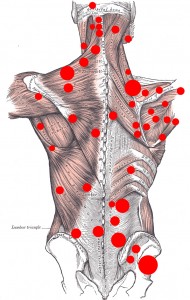
Trigger Point Therapy Salt Lake City Utah

  • Over-training and/or improper form
  • Muscle weakness
  • Car Accidents
  • Poor Diet
  • Starting a new exercise program
  • Trauma emotional and/or physical
  • Lack of sleep/sleep disorders

Trigger Point Therapy is a very common request from my clients in Salt Lake City, Utah. Trigger Point session’s have considerable benefit for those experiencing muscle pain, there are several things you can expect from your session. First I always make sure to locate the exact area of the Trigger Point and then lengthen the muscle. Then I apply a tolerable amount of pressure and hold it until I feel the spot release. Next, I use a strumming motion to “strip-out” the knot, making sure to move in the direction of the fiber orientation. This elongates the muscle that has been shortened by the Trigger Point. I then strip the muscle going each direction towards its attachment sites. Once I am working on the attachment sites, I use fast-moving friction with my finger tips to break up the knotted area. It’s always a good idea to end a Trigger Point session with stretching the areas that were bound up. When it comes to pain felt in these bodywork sessions, I work with a 5-7 scale. On a scale of 1-10, if my client feels that their pain has reached an 8, I will pull back into a more comfortable 5-7 range. Of course, there will be some pain involved due to the fact that Trigger Points are very tender and irritable.

From my experience working at chiropractic offices in Salt Lake City, Utah. I have found that a combination of Deep Tissue and Trigger Point bodywork are most effective in releasing tight muscles. I work on a lot of auto-accident victims and high-performance athletes. These 2 cases seem to have the highest concentration of trigger points, but anyone can get them, and they can get them anywhere. If you have had deep tissue sessions that have not given you results, then you may want to try Trigger Point Therapy. Many of my clients love it and request it for every session. If you’re looking for trigger point therapy in Salt Lake City, Utah call me today at (801) 349-3934 and see if Trigger Point may be just what you need to relieve your fatigued muscles.


Craniosacral Therapy: Unlocking your Body’s Ability to Heal Itself

Friday, September 3rd, 2010

Craniosacral Therapy (often mispelled cranialsacral or cranial sacral) is a fairly new type of therapy that is used to correct misalignments and inconsistencies in the Craniosacral system. This physiological system pumps fluid through your spine, around the outside of your brain and encloses the spinal cord, brain, spinal column, nerves and Cerebrospinal Fluid or CSF. CSF is a clear watery fluid that is circulating in our Central Nervous Systems at all times. In addition, CSF surrounds, feeds and cleans our brain and spinal cord. Below is a visual explanation of the Craniosacral system.

Call today for your free 20 minute craniosacral therapy session in Salt Lake City, Utah (801) 349-3934.

Craniosacral System

The pumping action that is generated in the Craniosacral system creates a pulse. This “pulse” was discovered by Dr. William Sutherland in 1899 and is now termed Cranial Rhythm. Craniosacral Therapy revolves around the practitioner’s ability to find this Cranial Rhythm. Although this rhythm is theoretical, I have physically felt it in many of my sessions. Once the rhythm is found, the therapist must concentrate to find any discrepancies in its movement.

“This therapy utilizes very gentle massage/manipulation of the brain, spinal cord, bones of the skull, sacrum and interconnected membranes.”

The Craniosacral Rhythm is the cycle of production and reabsorption of Cerebrospinal Fluid. When fluid is being produced, this is called Craniosacral Flexion. When the reabsorption occurs, it is referred to as Craniosacral Extension. Flexion resembles inhalation, and Extension, exhalation. This rhythm can be palpated or felt anywhere on the body - from the bottom of your feet to the top of your head.

This rhythm has certain characteristics, of course depending on how blocked and disarranged it is.

Symmetry - side to side movement. Flexion/Extension

Quality - a power scale ranging from 1-10. 1 being very weak and 10 being very strong. This movement can be rough, smooth, ratchety, thin etc..

Amplitude - width of travel. Bigger is better!

Rate - there will be 6-12 cycles per minute, just as we take 12-18 breaths per minute.

What you can Expect in a Session

So now that you know how it works, let me explain what a Craniosacral session consists of and just how this therapy is used to unlock your body’s ability to heal itself. This therapy utilizes very gentle touch/manipulation of the brain, spinal cord, bones of the skull, sacrum and interconnected membranes. There are several “listening station” that the practitioner can use initially to palpate the Cranial Rhythm. Once the rhythm is felt and evaluated, the therapist can pinpoint exactly where the work needs to be done based on where the rhythm can not be found in the body. That is where the work needs to be done, because that is where there is a blockage in the Craniosacral system.

Want a free 20 minute introductory craniosacral massage in Salt Lake City, Utah? Call me today (801) 349-3934.

The therapist will move on to place their hands and hold several points of the body from the pelvis to the top of the head. These sessions can last from 30 minutes to 2 hours in my experience and it all depends on how misaligned your body is. Once the session is over, your Craniosacral system becomes unblocked and your body can potentially heal itself! I won’t put a list of ailments that can be treated by Craniosacral Therapy because it can theoretically help with any problem you may be having from emotional/mental disorders to physical pain like neck/upper back pain. I have especially had success with auto-immune disease like Fibromyalgia, chronic migraines, depression, insomnia and memory problems.

Once the session is finished, many of my clients explain a feeling of extreme relaxation and peace. Although most clients will stay awake for their session, many report that they felt as if they were dreaming. This therapy can unlock intense mental pain as well so do not be surprised if you are overwhelmed with emotions during or after a session. This is an excellent therapy to try if you feel that other therapies have failed you or that you’re not getting the results you want from something else. This could be just what your body needs to heal. Call today to make an appointment and if you schedule before October 10, I am offering 20 minutes of FREE Craniosacral work. Don’t miss out on this amazing bodywork experience.

Be Aware of your Posture: Exercises for a Healthy Spine

Thursday, May 6th, 2010

Do you ever find yourself hunched over with your shoulders and head hanging forward? Do you notice that your upper back, neck and lower back often ache? I hear many people talk about the importance of good posture but how many of us really take the time to notice and correct it?

Our body structures work as one total unit. Just as a building is held together by framing, beams, panels and rebar, our bodies are held together with bones, connective tissue and joints. In a building, all of the materials must be sturdy enough to keep that structure from collapsing, and our bodies are no different. If one part of our structural unit is not working correctly, a chain reaction occurs. For example, if we slouch our shoulders, they will roll forward causing our upper back muscles to become over-stretched and our chest muscles, or pectorals, to become contracted. This can ,in turn, cause the head to roll forward and put pressure on our cervical (neck) muscles and adversely affect the curvature in our spine.

Before I explain a few simple exercises you can perform yourself to improve the curve in your spine, (and therefore helping to alleviate back/neck pain), here is an easy way to check how efficient your posture is:

  • Stand with the back of the head touching the wall. Heels should be six inches from the baseboard. With your buttocks touching the wall, check the distance with your hand between your neck and the wall. If you’re within two inches at the neck, you are close to a good posture. If not, the neck posture is too forward and can be subject to deterioration of joints and discs.

Looking for Salt Lake City Utah Massage Therapy? Contact me at (801) 349-3934.

In an ideal posture, your head should be standing tall, your shoulders back with your chest out, and your buttocks slightly sticking out to create a small but noticeable curve in your lower back.

The image on the right displays what your posture should look like. As you can see, the body on the left, has his head hanging forward and shoulders rolling forward, with his abdominal muscles pulled forward which causes an unhealthy curve in the spine.

Re-Patterning Exercises for the Spine:

Coming up from the Top of the Head:

This is to help you become aware of the top of your head. Slightly rock your head back and then pretend as if a skyhook is attached at the top of your head to pull you skyward. As you come up from the top of your head, your neck should become longer. Just let your arms and hands hang. Try to focus on doing this every time you notice that your head is rolling forward, or when you are slouching.

Roll up/Roll Down:

Stand with your back to the wall. Step with your feet out away from the wall a half step; your back should remain against the wall. Vertebrae by vertebrae, slowly roll down, starting with the head, towards the floor with your head, neck and shoulders as relaxed as possible. As you roll down, bend your legs at the knees to help in this motion as needed. Once you have completely rolled over, roll back up one vertebra at a time all the way to the head with your feet pushing into the floor as you roll. Make sure to push into the wall as you go up. This exercise will help to create length in the spine and decompress your vertebrae.

Stacking:

Start by standing with your feet parallel and less that shoulder-width apart. Next, roll down as if you are going into a modified child’s pose (a standing child’s pose if you will) where you will remain with your body folded, or rolled forward as far forward as is comfortable, i.e. in a squatting position. Rest the back of your hands on the floor (palms up) at your side, with your arms totally relaxed. Once you are in the modified child’s pose with your feet as close to flat on the floor as possible, act as if a skyhook is grabbing the top of your sacrum and slowly pulling you upward. Allow your upper body to just hang and be totally relaxed as your legs extend to the point just before your knees lock, keeping them slightly bent. Keep your arms and head relaxed - hanging down as you now begin to roll your spine up, stacking one vertebra at a time on top of your sacrum. As you are rolling up, you may feel spots that don’t move as freely as others. You should stop at any of the areas that feel stuck and take a deep breath into the back focusing on the area to loosen. Repeat the breathing at each segment that is stuck. Once you have rolled all the way up, relax your neck and shoulders and slowly let your head tilt forward, allowing the weight of your head to pull the rest of your spine along as you roll over one vertebra at a time. Finally, roll down as far as is comfortable and slowly roll back up one vertebra at a time repeating the process 3 to 5 times.

Circles:

Stand erect coming up form the top of your head and arms at your sides. Ball your hands up into fists with your thumbs out (as if you were hitch-hiking.) Raise your arms out to the side making sure both shoulders remain even. Squeeze your shoulder blades together and with your palms facing down toward the floor (thumbs pointed forward), rotate your arms in a 6 inch diameter circle forward, toward your extended thumb. To reverse the circles, turn your palms to face the ceiling and circle backward toward your extended thumbs.

NOTE: Start with 20 circles each direction once daily.

Some of these exercises may seem technical but once you try them 3 or 4 times you will get it and be able to do it whenever you get a spare minute during the day. Personally, I like to do these right when I wake up in the morning not only to get my spine loose and ready for the day, but it also helps me wake up and get the blood pumping through my veins.

At first, you may notice that your spine is not incredibly mobile and perhaps quite stiff. But in my experience, I have seen my clients improve mobility and decrease back pain just by doing these exercises once a day. It’s also a great way to stay aware of your body, your pain, and your posture.

If you’re looking for massage and bodywork in Salt Lake City, Utah please contact me at (801) 349-3934.

Deep Tissue Massage and How it Benefits You

Monday, March 15th, 2010

Deep Tissue Massage is all about reaching the deeper layers of muscles in your body and realigning your Fascia, or connective tissue. Fascia is an envelope of dense connective tissue that wraps around a region of muscles. It acts as an organizer for our muscles by compartmentalizing them.

For information on Deep Tissue Massage in Salt Lake City Utah contact me (801) 349-3934

In the 1930’s, Dr. Ida Rolf, a Biological Chemist, conducted a 30 year research study on the properties on Fascia. She found that these connective tissues could be manipulated and molded when heat is applied. And this heat is produced through deep tissue massage techniques. By using fists, knuckles, forearms and elbows, these techniques are achieved. With lighter, more superficial, swedish massage techniques only the superficial muscles can be reached and fascia is unlikely to be manipulated. Indefinitely, the effects of Deep Tissue massage last much longer than with Swedish techniques. And by performing deep, slow strokes your fascia and muscles will actually be lengthened! I have often measured the height of my clients before and after each session. It is not unusual for someone to lengthen in height by an inch or so at the end of their session! Lengthening of fascia has several benefits including:

  • Decreases muscle tightness
  • Improves posture
  • Increases flexibility
  • Increases range of motion and mobility

Deep tissue is especially helpful for chronically tense and contracted areas such as stiff necks and lower back pain. And this type of therapy is useful for all people. This can be very helpful for athletes who expose their muscles to intense daily conditioning. And in many cases, a deep tissue massage has replaced the classic Swedish massage in terms of frequency of use. People who have traditionally gone to spas and requested a relaxing swedish massage are now seeking out a massage that conditions and heals deep muscles.

Those suffering from chronic illnesses may also find deep tissue massage to be extremely therapeutic. Sufferers of chronic pain, Fibromyalgia, Multiple Sclerosis, and even Carpal Tunnel Syndrome may find significant relief from deep tissue massage. The deep pressure in these sessions stimulate circulation in areas of pain, therefore allowing them to heal.

What to Expect During and After Your Deep Tissue Massage Session

During your massage, you may feel some discomfort due to the deep pressure. But as tight muscles are worked and you are able to relax more, you may notice the muscles actually loosening during the session. You will also notice right away that your skin becomes warm which usually induces relaxation.

Once your session is over, you may experience muscle soreness for the next few days. In my experience, this soreness can be compared to the soreness you feel after a good work-out. But your muscles will definitely feel relieved and looser, and you should notice much more mobility in your overall structure.

If you’re looking for deep tissue massage in Salt Lake City contact me (801) 349-3934