Fibromyalgia: A Real Illness with Real Pain

May 30th, 2013

I have been wanting to write a blog about Fibromyalgia for quite some time, and feel that it would be refreshing to people who suffer from this unmerciful illness. I have been practicing for almost 5 years in Salt Lake City, Utah and have worked with many clients with Fibromyalgia.

I consistently hear the same story from these clients. They feel absolutely invalidated by their medical doctors, who tell them that this ailment is “all in their head.” And honestly I have grown tired of hearing that this happens. Just because a medical doctor cannot detect the cause of Fibromyalgia through a labratory test, does not mean that this pain is not absolutely real to the patient. I have felt strongly about writing this blog after working with several Fibromyalgia clients and realizing that most of them feel completely unsupported in their illness.

But not only do they feel unsupported by their medical professionals, but also by their friends and families. I would like to explain through this blog, and from my experience with Fibromyalgia sufferers, that this disease is a real, serious, painful disorder.

Fibromyalgia is defined as a chronic disorder characterized by widespread musculoskeletal pain, fatigue, and tenderness in localized areas. Your muscles may feel like they have been overworked or pulled. They’ll feel that way even without exercise or another cause. Sometimes, your muscles twitch, burn, or have deep stabbing pain.

Some patients with fibromyalgia have pain and achiness around the joints in the neck, shoulder, back, and hips. This makes it difficult for them to sleep or exercise. Other fibromyalgia symptoms include:

-abdominal pain
-anxiety and depression
-chronic headaches
-difficulty maintaining sleep
-dryness in mouth, nose, and eyes
-fatigue upon arising
-hypersensitivity to cold and/or heat
-inability to concentrate
-irritable bowel syndrome
-numbness or tingling in the fingers and feet
-stiffness

Fibromyalgia is a very mysterious illness in that there are no specific causes and there are no specific medical tests that diagnose it. However, upon physical examination, patients will be sensitive to pressure in certain areas of the body, called tender points. To meet the diagnostic criteria, patients must have widespread pain in all four quadrants of their body for a minimum duration of three months and at least 11 of the 18 specified tender points. The 18 sites used for diagnosis cluster around the neck, shoulder, chest, hip, knee, and elbow regions (more than 90% of these areas are myofascial trigger points). But this diagnostic technique seems to me to be quite vague. Shown below is an illustration of the typical spots for fibromyalgia pain.

image

I am fascinated that most Fibromyalgia sufferers’ that I have treated, tell me that they developed this illness very soon after an exceptionally stressful time in their lives. This suggests to me that perhaps Fibromyalgia affects those that do not handle stress very well. Or a better way to put it; these individuals were simply not wired to cope with high levels of stress.

Over the last 5 years in my practice, I have gained much respect for those that suffer from Fibromyalgia. They complain of unbearable pain through out their bodies, that causes staggering fatigue. And it’s tragic to me how this illness creates such a vicious pain cycle. It causes pain, then fatigue, then sleeplessness due to the pain, then more pain and fatigue from not acquiring proper amounts of sleep.

And because this illness affects every aspect of ones’ life and prevents them from truly living, a hopeless depression usually develops. And as mentioned before, many fibromyalgia patients do not have support from medical professionals, family or friends.

So what can be done to treat this incurable and mysterious disorder? Because fibromyalgia has no cure, there are many different types of medications and therapies that can be prescribed. Sleeping aids are commonly used to treat the sleep disorder associated with Fibromyalgia. Muscle relaxants and anti-depressants (ones that boost serotonin and norepinephrine) help with the physical and emotional pain. Other remedies include accupuncture, chiropractic work, physical therapy, and massage therapy.

When I began practicing therapeutic massage, I was reluctant to work with Fibromyalgia clients. I thought that massage might aggravate the pain and the triggerpoints. But now I realize that I was only being cautious because I did not understand Fibromyaglia pain. After working with these clients over the years, I have found massage therapy to be profoundly beneficial in decreasing their pain and triggerpoints. Probably 90% of my Fibromyalgia clients leave my office feeling significantly better.

Having Fibromyalgia can affect your circulation immensely, and one of massage therapy’s greatest benefits is that it increases circulation considerably. This alone helps to eliminate pain. Also, massage therapy relaxes the body and therefore relaxes the central nervous system (CNS). And through this sedation of the CNS, I see an amazing decrease in pain for my fibromyalgia clients. And knowing how much pain this illness truly brings, I feel a great reward when I can help decrease it.

Over time, with consistent massage therapy sessions, clients tell me that they feel better, for longer periods of time. If you or anyone you know is suffering from this painful disease, I encourage you to try a session here in Salt Lake City, Ut. I have seen these sessions facilitate a better quality of life, hope and of course eliminate intense pain. Call today at 801-349-3934 for more information or to schedule your first appointment.
Anatomy of the Iliotibial (IT) Band

April 26th, 2013

Sports Massage Therapy entails a lot of specific work. There are hundreds of sports that athletes are determined to master. But at my practice in downtown Salt Lake City, Utah, I find that athletes whom are constantly training end up with many similar injuries. One of these common injured areas includes the Iliotibial band, or IT Band.

The Iliotibial band (IT band) is a long flat fibrous band that runs all the way down the outside of the thigh connecting the Tensor Fasciae Latae muscle to the anterior tibia just below the knee. The Tensor Fasciae Latae originates from the anterior part of the outer lip of the iliac crest and from the outer surface of the anterior superior iliac spine or ASIS.

The IT band is very long and therefore plays a big part in our everyday movement. Surrounding it are some major muscles like the Gluteals, Hamstrings and Quadriceps. The tasks of the Iliotibial Band (ITB) are flexion, abduction, and medial rotation of the hip. In addition, the ITB contributes to lateral knee stabilization. I’ve always found it fascinating how the Tensor Fasciae Latae kind of turns into the Iliotibial Band, therefore acting through the band by pulling it superiorly and anteriorly. This can also be seen in the illustration.

Hopefully you now have a better understanding of the IT band and its function. But this band often baffles clients. I constantly hear questions like, “Why does the IT band always get so tight” or “What type of tissue comprises the IT band?” This second question is another subject that fascinates me.

The IT band is a different type of tissue. It’s not muscle or tendon or ligament specifically, but instead a strong, tendinous fascia. Although Tendons, Ligaments and Fascia are all made up of connective tissue, they are all slightly different. I like to think of the IT band as a mixture of very strong Tendon and Fascia. This is how I try to describe it to my clients. Because the tissue of the IT band is so thick and strong, it is likely to become very tight, especially with much activity.

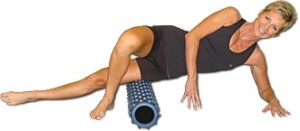
So which sports are mostly likely to affect your IT band? I see Runners and bikers that struggle the most with the IT band. If you are an avid walker, hiker, jogger or marathoner, I would suggest investing in a foam roller. Foam rollers are one of the most effective ways to loosen the IT band, because it is such a hard area to stretch. Below is a demonstration of how to use this foam roller on your IT band.
image

For some reason the woman in this photo has a big smile, but if you do this exercise, you won’t be smiling. It has always been a long running joke with many of my clients that the IT band always hurts because no one ever wants to stretch it out. Why is that? Because it can really hurt! But it will definitely feel better and looser after the fact, so don’t give up if you feel a little uncomfortable. You can find these foam rollers at your local Target or sports store, or just order one online.

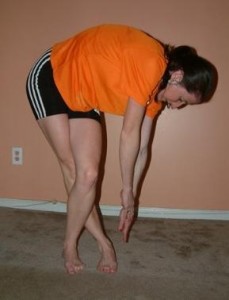
In my experience, however, it is not just runners and bikers who suffer from a tight IT band. It seems whether you are quite sedentary or a very active person, the IT band tends to become tense. The foam roller is a good option, but there are also stretches that can give some relief as well. Pictured below are 2 stretches that I use and recommend to my clients.
image
image

Make sure that you are really feeling the stretch on the outside of your thigh. It can be good to be in each stretch for 5 minutes or more, depending on how tight the IT band is.

And last but not least, of course massage is a huge benefit in relaxing the IT band. Several of my clients tell me that deep tissue bodywork is the only way that they feel relief in the IT band. Deep tissue is in fact very useful in lengthening the tissue. I usually will use what I like to call “The IT Sweep,” in which I have the client lie on their side. I then have them take the leg that is on top and flex it up and over the bottom leg, which exposes the hip of the leg on top. I proceed to take my elbow, and starting at the head of the femur, I “sweep” down the IT band all the way to the lateral side of the knee. This can be done 3-4 times to ensure the lengthening of that tissue. And honestly, it can be painful, just as the foam roller can be. But it works, and it works well.

After the IT sweep, I like to stretch the area. As mentioned before, it can be very difficult to stretch the IT band. But with assisted stretching from a licensed massage therapist or physical therapist, a deeper stretch can be achieved.

If you have concerns about your IT Band and want to hear more about treatment for it, please call me at 801-349-3934. I practice in downtown Salt Lake City, Utah and am always taking new clients. Call today to schedule your first appointment 🙂

Spring/Easter Massage Special 2013

March 7th, 2013

Spring has been highly anticipated this year in Salt Lake City, Utah. After an unusually chilly winter, I think we can all welcome Spring with open arms. We can look forward to sprouting tulips and daffodils, as well as sunnier days.

Also this Spring, I want to offer an incredible massage special to welcome the new season 🙂 Starting today and going until Easter Sunday, I am offering one-hour massages for just $45, 90 min massages for $70 and 2 hour massages for $100! This special will save you up to $20 on your massage session so call me today at 801-349-3934. And of course you can always take advantage of my ongoing special which includes 5 one-hour massages for the price of 4! All you have to do is buy the 4 massages upfront and receive the 5th for free.

You can take advantage of this for yourself, or buy a gift certificate for a loved one. Call me today in Salt Lake City, Utah to book a session and get a great deal this season. Happy Spring!

Rejuvenate Your Cardiovascular System with Massage

March 7th, 2013

If you’ve ever considered the complexity of the human body and how it works, you realize that the body is not just made up of blood, bones and muscle. I have been a bodyworker in Salt Lake City, Utah for over 4 years and I still am surprised at the fundamental intracacies of our human make-up. Our bodies are actually comprised of 12 different systems that allow us to operate as 1 functional unit.

Each system has an important and specific duty to perform that keeps us alive. The 12 systems include:

1. Muscular System
2. Cardiovascular/Circulatory System
3. Digestive System
4. Integumentary System
5. Endocrine System
6. Urinary System
7. Reproductive System
8. Lymphatic System
9. Immune System
10. Respiratory System
11. Nervous System
12. Skeletal System

Massage therapy influences and benefits every one of these systems. It would be difficult to determine which system is improved most by bodywork, but one system that highly profits is the Cardiovascular/Circulatory System.

Our Cardiovascular structure is an organ system that encompasses our blood, our heart and the blood vessels of the body. The cardiovascular system carries blood, oxygen, and nutrients to organs and tissues of the body, and carries waste and carbon dioxide from these tissues for removal from the body. This system may be seen strictly as a blood distribution network, but it also helps fight diseases and helps stabilize body temperature and pH to maintain homeostasis.

The heart functions as a pump to move blood through the blood vessels of the body. The Cardiovascular system is essential for large, multi-cellular organisms, such as humans and animals. One of this systems’ biggest responsibilities is to supply oxygen to each and every cell of the body. Once oxygen is transported to the cells, carbon dioxide is then removed as it is absorbed into the blood. A second critical function of this system is to feed all of our cells with nutrients and energy via the bloodstream. The cardiovascular system also transports hormones to wherever they must be delivered in the body.

So what benefits does massage therapy contribute to the Cardiovascualar/ Circulatory System? Basically, massage can help to speed up blood flow by mechanically assisting the venous flow. This, in turn, improves the overall circulation through out our bodies.

According to the Associated Bodywork & Massage Professionals, massage therapy can help improve blood flow to the tissues, muscles and vital organs; and increased blood flow is a key element of good health.

Other advantages provided by massage therapy to the cardiovascular system are:
- Dilated blood vessels helping them to work more efficiently, and decrease high blood pressure
- Hastened removal of waste products, like toxins and carbon dioxide
- Prevents muscle cramping due to sustained blood flow
- Increases white blood cell count, helping to prevent disease
- Reduces Lymphedema
- Reduces Ischemia, which is a reduction in the flow of blood to body parts, often marked by pain and tissue dysfunction
- Helps to preserve brain tissue, cognitive function and protect against strokes.

So perhaps you do not experience muscle pain or tightness. But if you suffer from high blood pressure, poor circulation, low-immune quality or have a family history of strokes, massage could be an excellent method of prevention for you. Give me a call today in Salt Lake City, Utah at 801-349-3934. Find out if massage could benefit you and your cardiovascular system.

Valentine’s Day Massage Special: 2 Hour Massage for $90

February 7th, 2013

Tis’ the season of Love in Salt Lake City, Utah and the gift of massage is an excellent choice for your partner this year. You can never go wrong with the gift of touch because its incredibly thoughtful and shows your partner how much you care. And of course, it just feels good!

This year, I have a great special that will make your loved one feel amazing and delightfully pampered. I am offering a wonderful 2 hour session that includes a full body massage, plus 30 minutes of Reflexology foot work for only $90. If you want to split up the 2 hours and make 2 separate sessions, that will work also. You can do whatever you would like with the 2 hours, depending on what will make your sweetie feel the best. I offer swedish, deep tissue, Myofascial release, sports therapy, craniosacral, and Reflexology. The session can be tailored to your preference.

I am offering this sweet massage session for only one more week. Purchase your gift certificate before Valentines Day and it can be used at anytime after that. Call me today in Salt Lake City, Utah to pick up your gift certificate or have me mail it to your Valentine. Your sweetie will definitely appreciate a gift like this.