Archive for the ‘Massage’ Category

Intermittent Fasting: Start Skipping Breakfast and Lose Fat

Tuesday, March 10th, 2015

5 years ago, I started this website which kick-started my business and has since cultivated a growing clientele for me in Salt Lake City, Utah. I’m very proud of this creation, which has helped me grow as a bodyworker, massage therapist and business owner.

But this website has also helped me grow as a blog writer. I have written about many topics concerning massage therapy and exercise. But today I’m excited to write about another aspect of human health- diet.

And when I say diet, I’m not referring to the act of dieting or restricting caloric intake. Dieting makes me think of what one does when they want to lose weight quickly, or jump onto the latest fad that promises extraordinary results in 30 days. I’m referring to YOUR diet, the steps that you take each day to put healthy things into your body. Dieting is a short-lived fad, but YOUR diet should be about always working towards a healthy lifestyle.

Intermittent fasting is a simple system, which is easy to follow, but can produce great health results. I’m not sure of where or how it originated, but countless studies prove that it just works. Contrary to popular belief that fasting is counterproductive or that it quickly puts your body into starvation mode, intermittent fasting can actually help you lose unwanted fat and increase the body’s ability to process the nutrients you consume. It also can make you less vulnerable to chronic illnesses.

Intermittent fasting (or IF as many people call it) revolves around restricting your eating for specific periods of time, and then eating your day’s worth of food during pre-determined “feeding windows.” It requires you to fast for 12-16 hours at a time, and eat within an 8 hour “window.” During this window, people will eat 2 meals. It is typical that these 2 meals will be eaten around noon and then at 8pm. But if your schedule does not permit this eating schedule, you can choose what works best for your life. If you prefer to eat earlier, try eating your meals at 10am and 6pm, or 2pm and 10pm. Essentially, this style of fasting requires you to skip breakfast and then not snack in-between meals. Easy enough!

When I try to explain this fasting concept, people often get hung up on certain ideas like, “But don’t I need to eat six small meals a day?” or “I will starve if I go 12 or more hours without eating.” But try to go into this with an open mind. If you think about it, people who eat 6 small meals a day don’t eat very much at once. Of course this does prevent your blood sugar from spiking, and helps control hunger. But the small portions help reduce high caloric intake as well. I believe this is one major reason that small portions work so well. If you eat 6 meals consisting of 200 calories, that’s 1200 calories in one day. But if you eat 2 meals a day, as you would with intermittent fasting, you might eat 500 calories in one sitting, amounting to 1000 calories. There is no requirement for caloric intake for either small meals or intermittent fasting. This is just an example of how many calories would be eaten, hypothetically.

Intermittent fasting is best understood when the physiological aspect is explained. Your body is in the fed state when it is digesting and absorbing food. Typically, the fed state starts when you begin eating and lasts for three to five hours as your body digests and absorbs the food you just ate. When you are in the fed state, it’s very hard for your body to burn fat because your insulin levels are high.

After that timespan, your body goes into what is known as the post–absorptive state, which is just a fancy way of saying that your body isn’t processing a meal. The post–absorptive state lasts until 8 to 12 hours after your last meal, which is when you enter the fasted state. It is much easier for you body to burn fat in the fasted state because your insulin levels are low. When you’re in the fasted state your body can burn fat that has been inaccessible during the fed state.

And if you think eating every 12 to 16 hours is impossible, think about your sleep schedule. If you sleep 8 hours a night, maybe from midnight until 8am, that is already 8 hours in which you are not ingesting food. If you ate dinner at 10pm, then by time you wake up at 8am, it will have been 10 hours without food. You would only need to wait 2 more hours, at 10am to eat your first meal of the day. Some people find it very challenging to go the full 16 hours, and you don’t have to, but the longer you wait to eat, the more fat that is turned into fuel. Intermittent fasting is ideal for people who tend to skip breakfast anyways.

If breakfast is the most important meal of your day, this may not be the best plan for you, but if you are looking to shed some serious pounds of fat, this is an incredible plan. It’s all about changing WHEN you eat and not WHAT you eat. Of course this doesn’t mean you can eat dough nuts and cheeseburgers for your 2 meals, but you don’t have to make a massive change to your diet. It’s always good to eat plenty of veggies and a good amount of healthy fats, which keep your body satiated for much longer. This will prevent snacking in between your 2 meals.

And there you go. Intermittent fasting is very straight forward and most importantly to me, it’s easy. You don’t have to prepare a ton of meals ahead of time and you don’t have to diet, which usually means eating the same stuff all the time, and feeling restricted.

I have always believed that if something is not working in your diet, or you really are wanting to lose weight, it never hurts to try different things. If Intermittent fasting sounds like it could work for you, remember to give it 4-6 weeks to begin seeing results. Please don’t hesitate to ask me for more info or call me in Salt Lake City, Utah at 801-349-3934. And of course, good luck!

 

Myofascial Therapy: The Chronic Pain Cure-all

Thursday, November 21st, 2013

Over the past few years, I have written several blogs specifically about the types of modalities that I use in my massage practice in Salt Lake City, Utah. I am actually surprised that I never wrote one about Myofascial Therapy, as it is a staple in most of my treatments. Last month’s blog, I chose Fascia as my subject and wanted to follow up with a blog specifically about Myofascial Therapy because it is a treatment that particularly works with the Fascia. And the reason that I have converted to using Myofascial treatments in almost every massage session, is because it is powerful. Not only can it affect muscle tissue, ligaments and tendons; but can also directly improve the structural integrity of your body.

From last month’s blog, you will remember that Fascia is a web-like structure of connective tissue that provides support and protection for most structures within the human body, including muscle. In the illustration to the left, the fascia is the white parts surrounding the muscles. Fascia acts to compartmentalize each muscle individually as well as each group of muscles. It also surrounds blood vessels and nerves. You could say it works as a binding agent to keep everything in it’s place. So Myofascial Therapy, also commonly called Myofascial Release, affects Fascia directly. The primary goal of this therapy is to eliminate chronic muscle pain, and loosen tight Fascia that is restricting muscles, and therefore restricting movement of neighboring structures, like joints and bones. Once the Fascia is released, the entire body can move freely. I guess that is why it is called Myofascial RELEASE.

Now that you understand the important role that Fascia plays in the body, and that it affects each muscle directly, I would like to describe the 3 types of muscles that we carry in our structures. These 3 categories include Cardiac Muscle, Smooth Muscle and Skeletal Muscle.

Cardiac Muscle - Cardiac muscle (heart muscle) is involuntary striated muscle, located in the walls of the heart; striated, meaning the cell fibers are aligned in parallel bundles, so that their different regions form stripes. Of course, these stripes would only be visible under a microscope. Cardiac muscle cells, like all tissues in the body, rely on an ample blood supply to deliver oxygen and nutrients and to remove waste products such as Carbon Dioxide. In the up-close picture below, you will see what cardiac muscle tissue looks like and also that it is striated. The striated tissue has visible stripes.

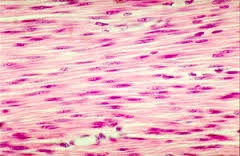
Smooth Muscle - This is involuntary non-striated muscle tissue. Smooth muscle is primarily located within the walls of blood vessels, small arteries, arterioles and veins. It is also found in lymphatic vessels, the bladder, the male and female reproductive tract, gastrointestinal tract and respiratory tract. You can even find this muscle in the iris of the eye. Smooth muscle does not contain striation, or stripes. And the cells are more of a spindle shape.

Skeletal Muscle - Skeletal muscle is responsible for our bodies’ mechanical system, which moves the limbs and other parts of the body. Like Cardiac muscle, Skeletal muscle is striated; however, unlike the other two types, this muscle is voluntary. All Skeletel muscle is connected to bone. These are the muscles we can see and feel through our skin. Also, this muscle tissue is what is directly affected from Myofascial Therapy. Once the Fascia is manipulated through Myofascial work, the muscles are loosened, freeing the body of any restrictions. The pain inflicted by immobility in the muscles can be very painful, and over time, can become extremely unbearable and chronic. Illustrated below is skeletal muscle, lying just beneath our skin.

So how do you know if you are suffering from Myofascial pain? I would like to go over the symptoms commonly felt with Myofascial pain and explain what can potentially cause it. Symptoms include:

  • Chronic back/neck pain
  • Headaches
  • Muscle spasms
  • Strange sensations such as numbness, pins and needles, burning, or a deep ache
  • Sciatica
  • Breathing difficulties
  • Reduced Flexibility

These are just a few of the debilitating outcomes of Myofascial tension. It is important to treat these issues before they worsen. As they become more chronic and more painful, the more the structural integrity of your skeletal system is compromised. You must consider the body to be like a machine. Many different components make our bodies operate as one functional unit. When there are a few components working improperly, it can throw off the entire machine. Leaving myofascial conditions untreated, your posture will become weakened. And like a chain reaction, the symptoms and imbalances will continue to worsen.

You must be wondering what causes these imbalances and Myofascial pain to begin with. There are countless. The world we live in today is physically and emotionally demanding. Here are some common causes of chronic pain:

  • Poor posture
  • Repetitive motions, such as painting or working on a computer
  • Standing or sitting for long periods of time
  • Emotional stress
  • Lack of stretching
  • Inflammation
  • Injuries

These causes are very broad, but basically anyone can start to feel Myofascial pain simply from the everyday demands of life. There are a few specific syndromes related to Myofascial pain like Myofascial Pain Syndrome and Fibromyalgia. Both of these disorders can be diagnosed by your doctor and are associated with specific Myofascial trigger points. These points are basically knots in the muscle tissue that are palpable and painful. These conditions can affect people’s lives in terrible ways. During a flare-up, there will be increased inflammation and pain, sometimes preventing someone from even getting out of bed.

If any of the above symptoms affect you, or you or someone you know is suffering from any type of pain syndrome, please call today to schedule a Myofascial treatment session. In my experience as a massage therapist, in Salt Lake City, Utah, this is one of the greatest forms of pain management that is out there. If you are suffering from pain, don’t hesitate to call me at 801-349-3934 to schedule an appointment. I will also give you tips and stretches, for improving pain outside of the therapy sessions. Don’t get used to chronic pain. Let me help you improve your quality of life!

What is Fascia?

Sunday, September 8th, 2013

When I was attending massage therapy school in Salt Lake City, Utah, I always heard students and instructors referring to the word, Fascia. I will admit, for a short while, I had no idea what it was. Pronounced “Fash-shuh”, this seemingly mysterious term had me determined to get to the bottom of it. I knew it was a noun and an anatomical term, but not much else.

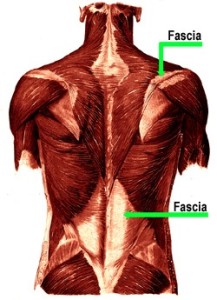
I wanted to write a blog dedicated to Fascia because it is a complex and fascinating type of tissue that essentially holds our bodies together. Simply defined, Fascia is a layer of fibrous connective tissue. But when I started to really research Fascia, I found that the word is Latin, standing for “band.” And that’s exactly what it is. Pictured below is a view of the muscles and fascia of the back.

image

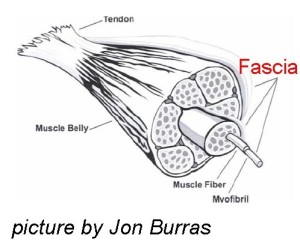
Fascia is a structure of connective tissue that surrounds muscles, groups of muscles, blood vessels, and nerves. Each individual muscle is encased in fascia, as is each group of muscles. I understood Fasica more easily when I realized that it essentially acts as a compartmentalizer. It makes sure everything in the body stays in its place and keeps the muscle fibers bound together. Below is a simple illustration of how the fascia wraps around the muscle and the muscle fibers.

image

In my anatomy courses, one of my instructors tried to paint a more tangible picture of what Fascia’s texture is like. She told us to picture a piece of raw chicken. When you separate the skin from the piece of chicken, you will see a sheet-like type of tissue that lies in-between. That is the Fascia.

Now, there are 3 classifications of fascia in the body. Superficial fascia, Deep (or muscle) fascia, and Visceral fascia. Lets take a closer look at these.

Superficial Fascia

Superficial Fascia is the loose, fatty connective tissue underlying the skin and binding it to the parts beneath. It is also known as Hypodermis. This layer primarily determines the shape of a body and surrounds organs and glands. It serves as a storage medium.

Deep Fascia

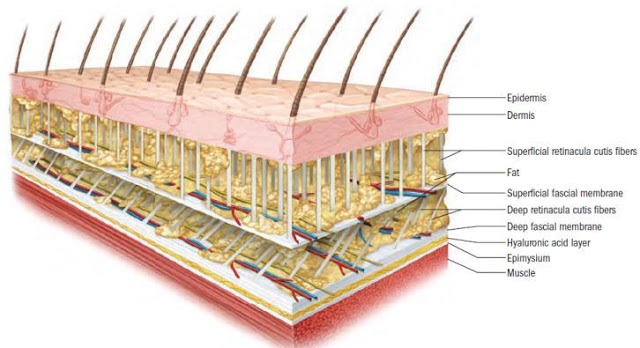
Deep Fascia is a layer of fibrous connective tissue which surrounds individual muscles and also divides groups of muscles. This dense fibrous connective tissue surrounds the muscles, bones, nerves and blood vessels of the body. The high density of collagen makes this deep fascia very strong. Pictured below are the different layers of the skin and muscle, and you will notice the superficial and deep fascia illustrated here.

imageVisceral Fascia

Visceral fascia suspends the organs within their cavities and wraps them in layers of connective tissue membranes. Each of the organs is covered in a double layer of fascia. These layers are separated by a thin membrane. The outermost wall of the organ is known as a parietal layer. The skin of the organ is known as the visceral layer. Below is a picture of woman being treated with Visceral manipulation. During massage treatments, it is extremely important to affect the fascia. Working with the visceral fascia specifically, can hugely benefit those with recurring musculoskeletal pain and postural distortions.

image

In addition to the 3 categories of fascia, there are 7 Fascial bands designed to wrap our bodies in segments. These bands help our bodies stay upright by exerting outward pressure on our tissues. These bands include the Eye Band, Chin Strap, Collar Band, Chest Band, Umbilical Band, Inguinal Band, and the Pubic Band. Fascial bands are structural bridges that mechanically link the skin, subcutaneous layer, and deeper muscle layers.

Much of the bodywork that I perform at my office in Salt Lake City, Utah, has to do with Fascial manipulation. This type of work is referred to as Myofascial treatment and has proved to be a very effective type of bodywork. It does more than just relax and loosen the muscle tissue, but helps restore muscles to their correct shape. Fascia must be worked on slowly and deeply. It warms the tissue and then can be manipulated accordingly. If you want more information about Fascia or are interested in getting a Myofascial session, please call today at 801-349-3934

Integrate Yourself With Yoga

Thursday, June 27th, 2013

When my clients ask me what they can do in between massage therapy treatments, I often suggest that they practice Yoga. I have found Yoga to be profoundly healing in several different aspects. And not only have I witnessed it with several of my clients, but firsthand with my own body.

I’ve been doing bodywork in downtown Salt Lake City, Utah for almost 5 years, and I have regularly turned to Yoga to alleviate my own pain. In this day and age, most of our professions require very repetitive movements over the course of several hours. This repetition can wreak havoc on muscles, joints and our entire skeletal structure.

For example, my profession requires me to stand for long periods of time, with a slight lean. This can put much pressure onto the lower back. Of course, there is much to be said for keeping healthy posture, but I know it can be hard to maintain it and be aware of it at all times.

When I began my massage therapy career, I almost immediately started to feel the aches and pains associated with a physically demanding job. At the time, I was working in a chiropractic clinic. I remember coming home from work some days, and lying on my living room floor because it was the only relief from my intense lower back pain. I felt discouraged and began thinking that this was not a good career choice. I loved the work I did, but thought it might be too taxing on my body.

After 2 months of aggravating low back pain, a friend of mine suggested I try Yoga. I knew it couldn’t hurt to investigate. After 2 sessions of yoga, I felt incredibly better. After 6 sessions, my lumbar pain was gone and has never again returned. And these days I use both yoga and massage therapy for body maintenance.

Yoga and bodywork are actually similar in many ways, in my opinion. They can both be used for maintenance to uphold our bodies’ structural integrity. They are both meditative practices, calming the mind and the spirit, and providing effective relief from stress. Of course, they both greatly heal muscles by lengthening and relaxing the tissue. And either of these treatments are valuable in preserving a healthy spine.

So what is yoga and where does it come from? Yoga is a mind-body practice that combines stretching exercises, controlled breathing and relaxation. It is an ancient Indian body of knowledge that dates back more than 500 years ago. It fasciantes me that Yoga is not just an exercise or assortment of strengthening poses, but its very own philosophy. The word “Yoga” came from the Sanskrit word “yuj” which means “to unite or integrate.” In order for man to be in harmony with himself and his environment, he has to integrate the body, the mind, and the spirit.

People who practice yoga believe that the body must be treated with care and respect, for it is the primary instrument in man’s work and growth. And I am a firm believer in honoring your body, because of the many ways that it serves you in your lifetime.

I’ve mentioned above a few of the benefits of yoga, but what else can it do for us?

- Yoga increases flexibility. I am frequently telling my clients to stretch every day, to avoid daily aches and pains. You could say Yoga encompasses the art of stretching and flexibility.

- It increases muscle strength and improves athletic performance. Many of the athletes I work on practice yoga to cross train. It helps build strength, especially in the core and shoulder girdle.

- Yoga can balance your metabolism and encourage weight-loss. Not only does this exercise stretch you out and strengthen you; it is a great way to burn a lot of calories!

- And due to Yoga’s stress-reducing properties, many dysfunctions can be eliminated like: Insomnia, high blood pressure, headaches, and negative thoughts.

I obviously am a huge fan of Yoga and encourage everyone to just try it once. Just like everything else, it’s not for us all. But I know that when I found it, it freed me from intense physical pain.

You can find Yoga studios almost anywhere. They are certainly quite popular here in Salt Lake City, Utah and all across the United States. I suggest buying a DVD initially and trying it at home. If you feel good after your first session, try calling a local yoga studio or signing up for a class at your gym. I prefer practicing yoga on my own, in my home. Because of its meditative qualities, Yoga works best for me when I’m all alone. It helps me better connect to my body and my thoughts.

But the beauty of this practice is that it’s completely individualized. What might feel good to someone, may not feel good to another. You must find which poses feel best to you, how long to hold your poses, and which do not feel good. It certainly is a liberating experience to create such body awareness in yourself. If you want more info about Yoga, flexibility or bodywork, please call me at 801-349-3934 today. Namaste.

Fibromyalgia: A Real Illness with Real Pain

Thursday, May 30th, 2013

I have been wanting to write a blog about Fibromyalgia for quite some time, and feel that it would be refreshing to people who suffer from this unmerciful illness. I have been practicing for almost 5 years in Salt Lake City, Utah and have worked with many clients with Fibromyalgia.

I consistently hear the same story from these clients. They feel absolutely invalidated by their medical doctors, who tell them that this ailment is “all in their head.” And honestly I have grown tired of hearing that this happens. Just because a medical doctor cannot detect the cause of Fibromyalgia through a labratory test, does not mean that this pain is not absolutely real to the patient. I have felt strongly about writing this blog after working with several Fibromyalgia clients and realizing that most of them feel completely unsupported in their illness.

But not only do they feel unsupported by their medical professionals, but also by their friends and families. I would like to explain through this blog, and from my experience with Fibromyalgia sufferers, that this disease is a real, serious, painful disorder.

Fibromyalgia is defined as a chronic disorder characterized by widespread musculoskeletal pain, fatigue, and tenderness in localized areas. Your muscles may feel like they have been overworked or pulled. They’ll feel that way even without exercise or another cause. Sometimes, your muscles twitch, burn, or have deep stabbing pain.

Some patients with fibromyalgia have pain and achiness around the joints in the neck, shoulder, back, and hips. This makes it difficult for them to sleep or exercise. Other fibromyalgia symptoms include:

-abdominal pain
-anxiety and depression
-chronic headaches
-difficulty maintaining sleep
-dryness in mouth, nose, and eyes
-fatigue upon arising
-hypersensitivity to cold and/or heat
-inability to concentrate
-irritable bowel syndrome
-numbness or tingling in the fingers and feet
-stiffness

Fibromyalgia is a very mysterious illness in that there are no specific causes and there are no specific medical tests that diagnose it. However, upon physical examination, patients will be sensitive to pressure in certain areas of the body, called tender points. To meet the diagnostic criteria, patients must have widespread pain in all four quadrants of their body for a minimum duration of three months and at least 11 of the 18 specified tender points. The 18 sites used for diagnosis cluster around the neck, shoulder, chest, hip, knee, and elbow regions (more than 90% of these areas are myofascial trigger points). But this diagnostic technique seems to me to be quite vague. Shown below is an illustration of the typical spots for fibromyalgia pain.

image

I am fascinated that most Fibromyalgia sufferers’ that I have treated, tell me that they developed this illness very soon after an exceptionally stressful time in their lives. This suggests to me that perhaps Fibromyalgia affects those that do not handle stress very well. Or a better way to put it; these individuals were simply not wired to cope with high levels of stress.

Over the last 5 years in my practice, I have gained much respect for those that suffer from Fibromyalgia. They complain of unbearable pain through out their bodies, that causes staggering fatigue. And it’s tragic to me how this illness creates such a vicious pain cycle. It causes pain, then fatigue, then sleeplessness due to the pain, then more pain and fatigue from not acquiring proper amounts of sleep.

And because this illness affects every aspect of ones’ life and prevents them from truly living, a hopeless depression usually develops. And as mentioned before, many fibromyalgia patients do not have support from medical professionals, family or friends.

So what can be done to treat this incurable and mysterious disorder? Because fibromyalgia has no cure, there are many different types of medications and therapies that can be prescribed. Sleeping aids are commonly used to treat the sleep disorder associated with Fibromyalgia. Muscle relaxants and anti-depressants (ones that boost serotonin and norepinephrine) help with the physical and emotional pain. Other remedies include accupuncture, chiropractic work, physical therapy, and massage therapy.

When I began practicing therapeutic massage, I was reluctant to work with Fibromyalgia clients. I thought that massage might aggravate the pain and the triggerpoints. But now I realize that I was only being cautious because I did not understand Fibromyaglia pain. After working with these clients over the years, I have found massage therapy to be profoundly beneficial in decreasing their pain and triggerpoints. Probably 90% of my Fibromyalgia clients leave my office feeling significantly better.

Having Fibromyalgia can affect your circulation immensely, and one of massage therapy’s greatest benefits is that it increases circulation considerably. This alone helps to eliminate pain. Also, massage therapy relaxes the body and therefore relaxes the central nervous system (CNS). And through this sedation of the CNS, I see an amazing decrease in pain for my fibromyalgia clients. And knowing how much pain this illness truly brings, I feel a great reward when I can help decrease it.

Over time, with consistent massage therapy sessions, clients tell me that they feel better, for longer periods of time. If you or anyone you know is suffering from this painful disease, I encourage you to try a session here in Salt Lake City, Ut. I have seen these sessions facilitate a better quality of life, hope and of course eliminate intense pain. Call today at 801-349-3934 for more information or to schedule your first appointment.